
VIATOR
RevolutioniSing Operator Pricing Connectivity at Viator

Problem
Viator faced a significant challenge with the lack of effective pricing connectivity for operators.
This limitation hindered operators from providing an up-to-date set of retail rates easily.
The consequences included potential inaccuracies for consumers, technical inferiority compared to competitors, and a notable impact on Viator's market positioning.
Opportunity
Viator identified a golden opportunity to pioneer an industry-leading, scalable Pricing API.
The envisioned API aimed to:
Support diverse pricing structures of reservation system partners.
Facilitate timely and efficient updates for retail rates.
Establish seamless and light-touch connections to maximize adoption rates.
Overall goal of the research
The overarching goal of the research was to develop a comprehensive understanding of pricing capability deficiencies and opportunities affecting the operator experience.
My role
In tackling this challenge, my role encompassed various crucial aspects:
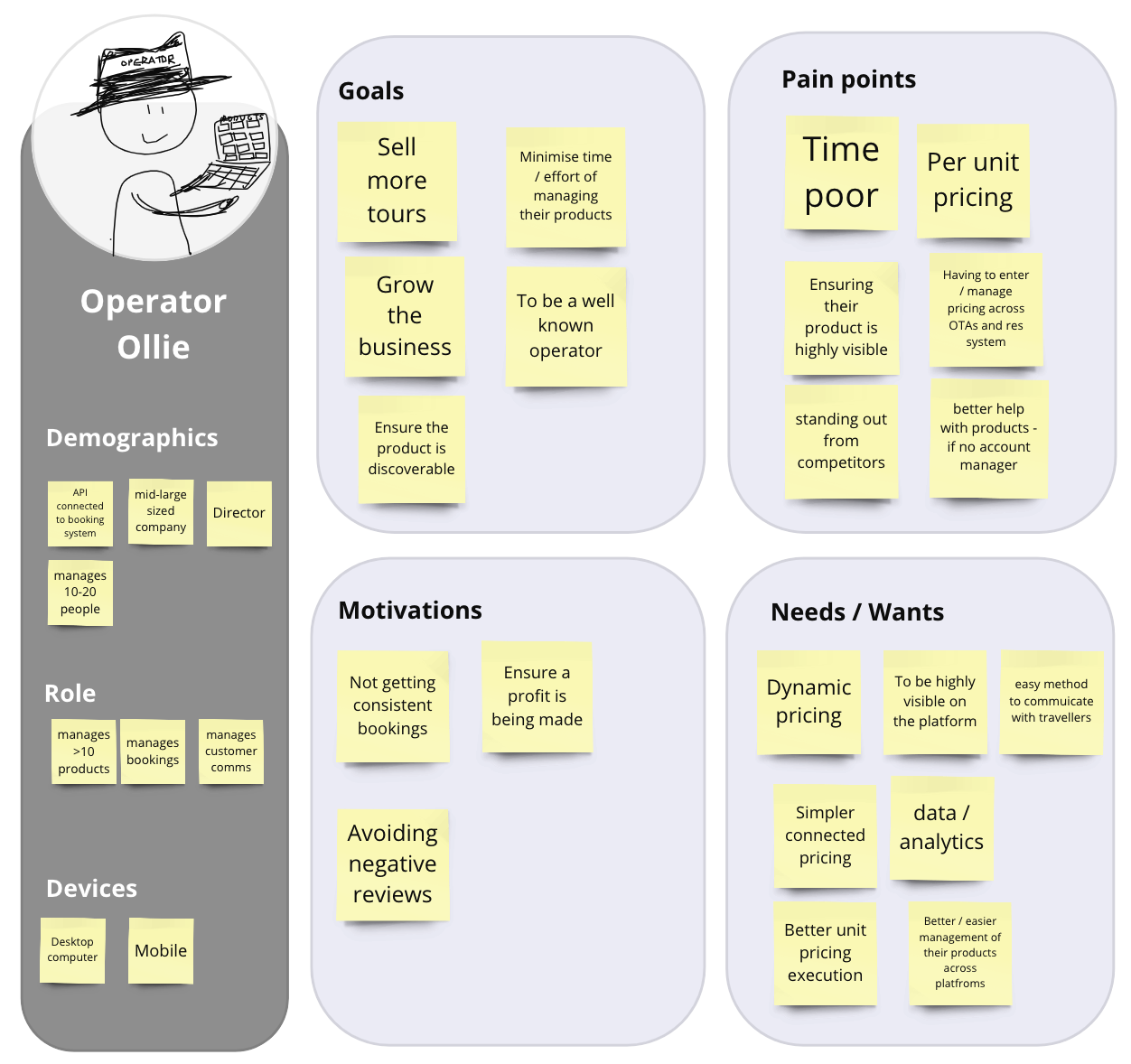
Persona Development: Crafting detailed personas, including Operator Ollie, to understand diverse user needs.
Customer Journey Mapping: Documenting Operator Ollie's journey, from connecting to a reservation system to pricing on Viator.
Competitor Analysis: Examining competitors like GYG and Klook to glean insights into real-time pricing and inventory management.
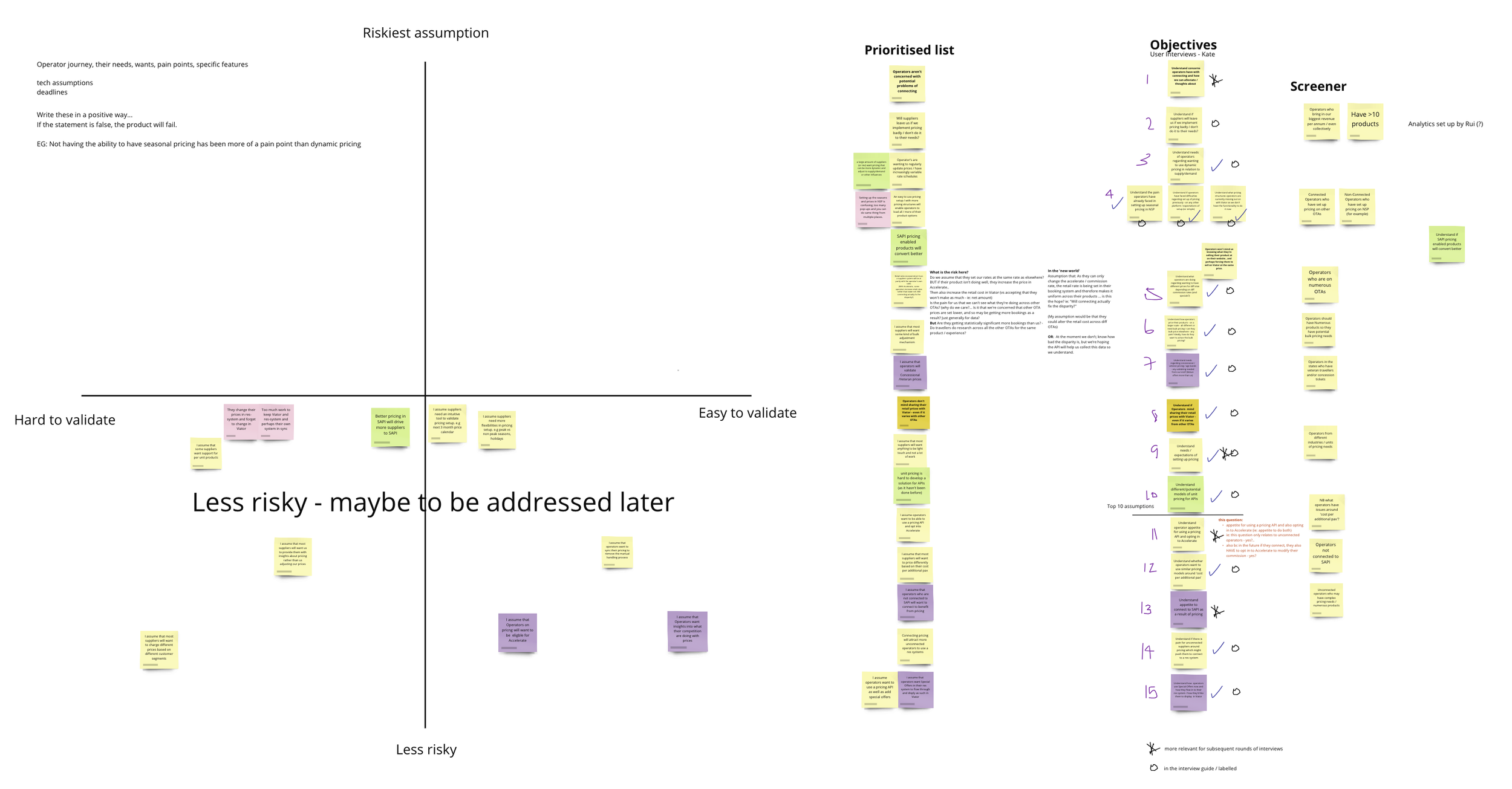
Risky Assumptions Workshop: Collaborating to define research objectives and key assumptions.
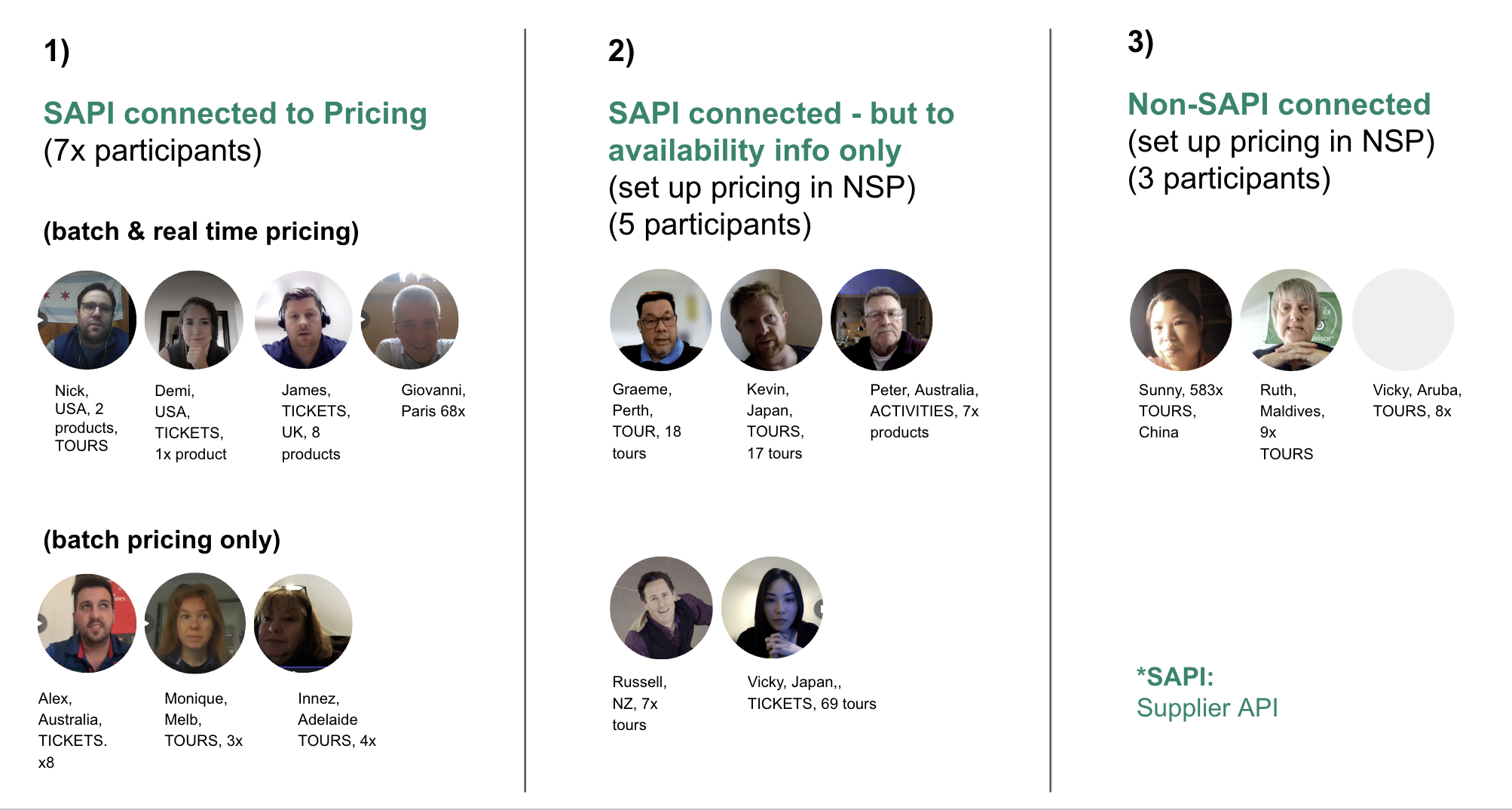
User Interviews: Conducting three rounds of interviews with operators, focusing on different personas.
Synthesis and Presentation: Analysing findings and presenting research insights to inform future steps.
Recommendations: Providing actionable recommendations for continuing research and potential features.
Persona - Operator Ollie
Customer Journey - Operator Ollie’s connection to the Pricing API
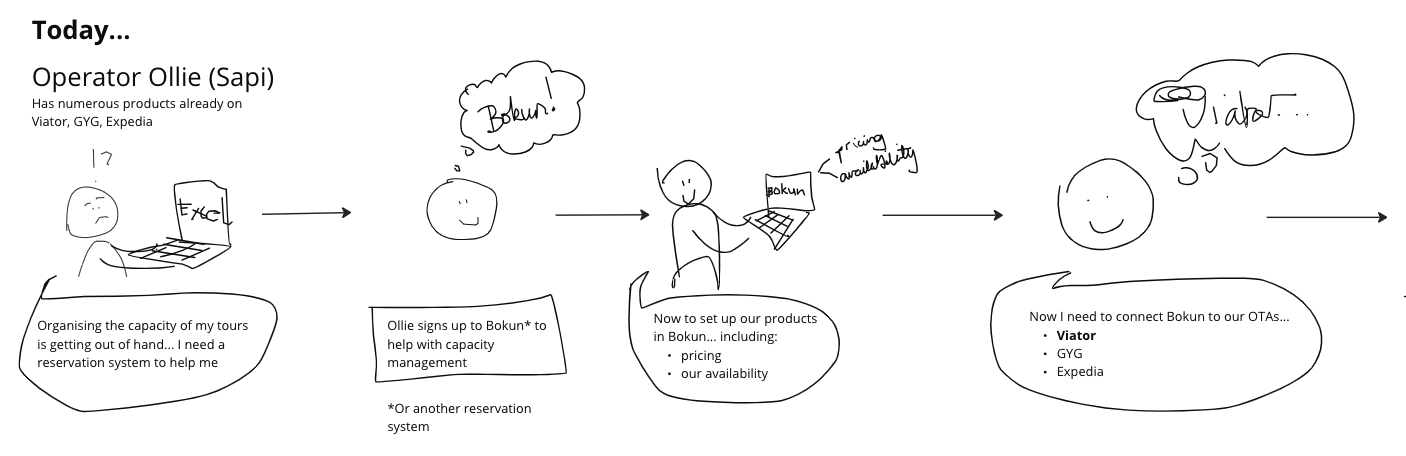
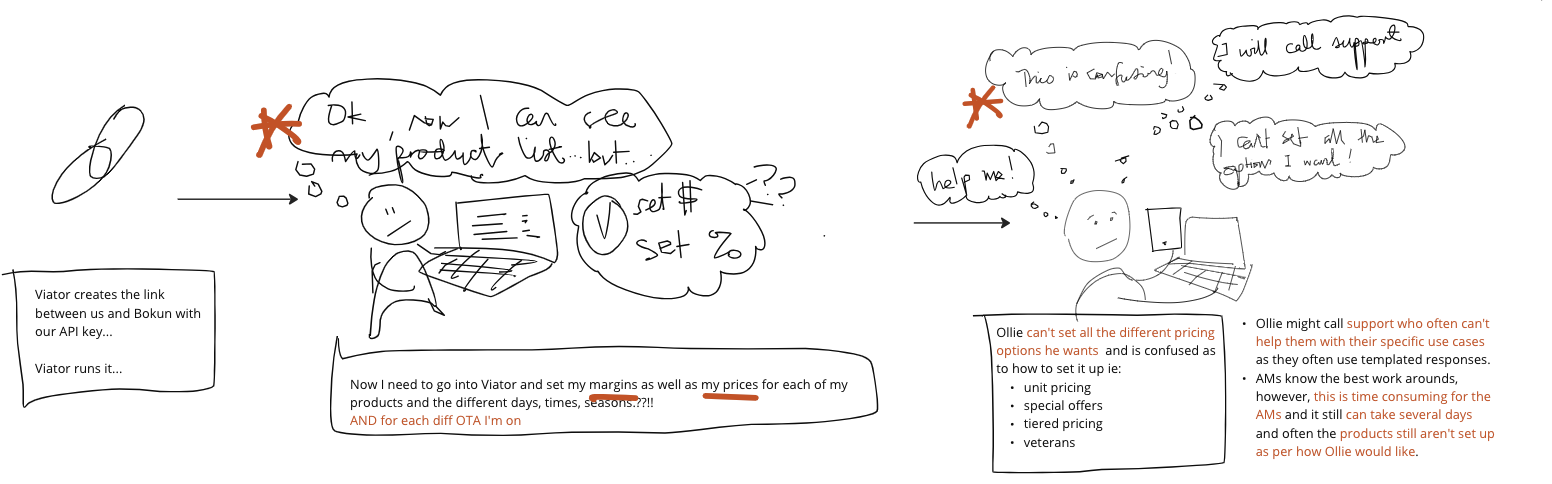
Ollie, facing capacity challenges as his company grows, adopts a reservation system.
He connects this system to various OTAs such as Viator, GYG, and Expedia.
Currently, Ollie manually configures prices on both the reservation system and Viator's platform (NSP), leading to redundancy.
He encounters confusion during setup, struggling with unit pricing and special offers.
Despite imperfect configurations, Ollie connects, but support often provides templated responses, which don’t solve his problem.
Account managers offer workarounds, but the process is time-consuming, resulting in delayed and sub-optimal product setups.
Competitor analysis
Get Your Guide offered real-time pricing via their API, while Klook provided a pricing and inventory management system.
Unit pricing execution was a common challenge among competitors.
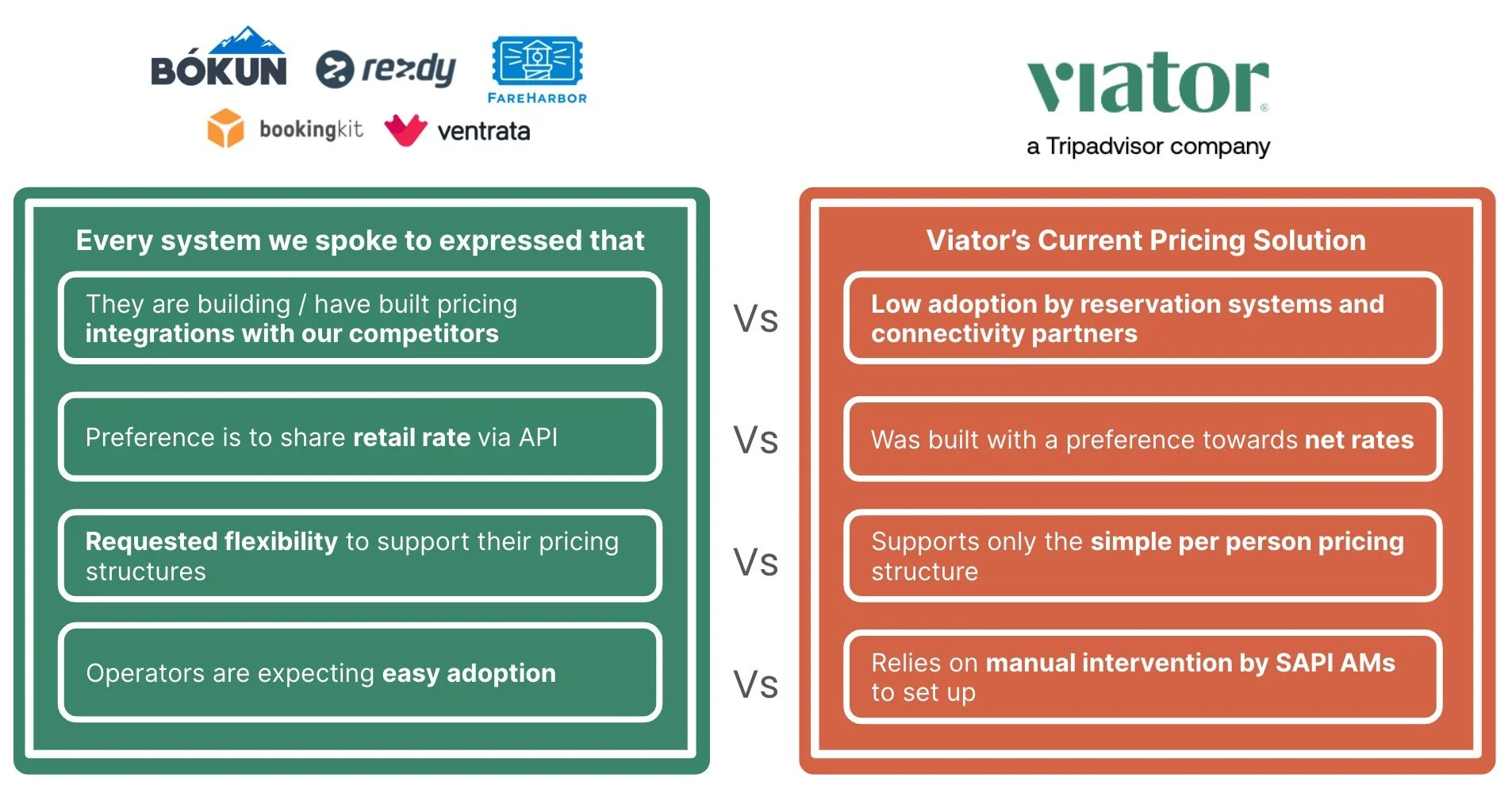
What the Reservation systems are asking for Vs our pricing offering
Risky Assumptions Exercise
Research method
3x rounds of operator interviews were conducted
This ensured pain points for the different groups were noted
Why this many operators?
Three users are enough to get an idea of the diversity in user behaviour and insight into what's unique and what can be generalised…
As you add more and more users, you learn less and less because you will keep seeing the same things again and again - Norman Neilsen
Findings
Operators expressed eagerness to connect to the Pricing API, citing minimal concerns.
"No concerns - just get it done"
Operators affirmed their loyalty to Viator, even if pricing implementation faced challenges.
“If we were to say, ‘see you later’, it's a big risk to our business”
Seasonal pricing was desired but considered difficult to implement for some operators.
“My God. That's just that sounds very exhausting to me.”
Dynamic pricing intrigued half of the connected operators, while the other half deemed it unsuitable.
“it is something that we are looking to do, but we've got to have the tech to do that first”
“The problem we've had in the past is if we charge more and it's really busy, people feel that they're not getting value for money (more expensive / lower quality tour)”
Operators needed pricing set up to be easy and automatic as they’re time poor
Wanted ‘add-on’s to be available
Operators prefer uniform retail prices across all OTAs to simplify operations.
Managing prices across multiple OTAs is viewed as a tedious and error-prone task.
The desire is to enter prices once and have them automatically reflected across all OTAs.
Unit pricing is not a pain point for the interviewed operators - more research needed with the specific persona group.
Operators not connected to Pricing express interest in connecting, but awareness is an issue.
Unconnected suppliers show little pain in connecting, indicating readiness hinges on specific operational challenges.
Limited usage of special offers post-COVID; if utilised, operators seek flexibility and ease of use.
Post-COVID, operators prioritise maintaining full tours over offering discounts to preserve brand value and partnerships.
Aha moments
Operators won't leave Viator solely due to pricing challenges, emphasizing the platform's significance.
Dynamic pricing emerged as a future trend, necessitating Viator's readiness.
No OTA currently enables operators to personalise product displays fully, presenting an opportunity for Viator.
All operators not connected to Pricing were interested in connecting.
If operators could have more things automated - ie: both availability and pricing, they would.
Therefore, the pricing api needs to be updated for the ability to scale, get ahead of the competition.
High level recommendations
User-Friendly Pricing API:
Ensure the Pricing API is easy to implement and user-friendly for operators.
Enhanced Seasonal Pricing Implementation:
Improve the experience of implementing varying pricing schedules, especially seasonal pricing.
Dynamic Pricing Consideration:
Acknowledge the prevalence of dynamic pricing and incorporate solutions to address operator concerns.
Flexible Product Options:
Research and implement flexibility for product options, add-ons, and product bundling.
Unit Pricing Exploration:
Conduct further research on unit pricing, particularly for private tours, canoes, cars, and ATVs.
Educational Outreach:
Educate both availability-connected and non-connected operators on the existence and benefits of the Pricing API.
Lower Priority Features:
Age bands/validation and special offers were deemed lower priority, considering the minimal pain points for operators.
This case study outlines the intricate process of identifying challenges, opportunities, and user needs within Viator's pricing connectivity. The insights gained pave the way for strategic improvements and innovations to enhance the operator experience and maintain Viator's competitive edge in the market.